

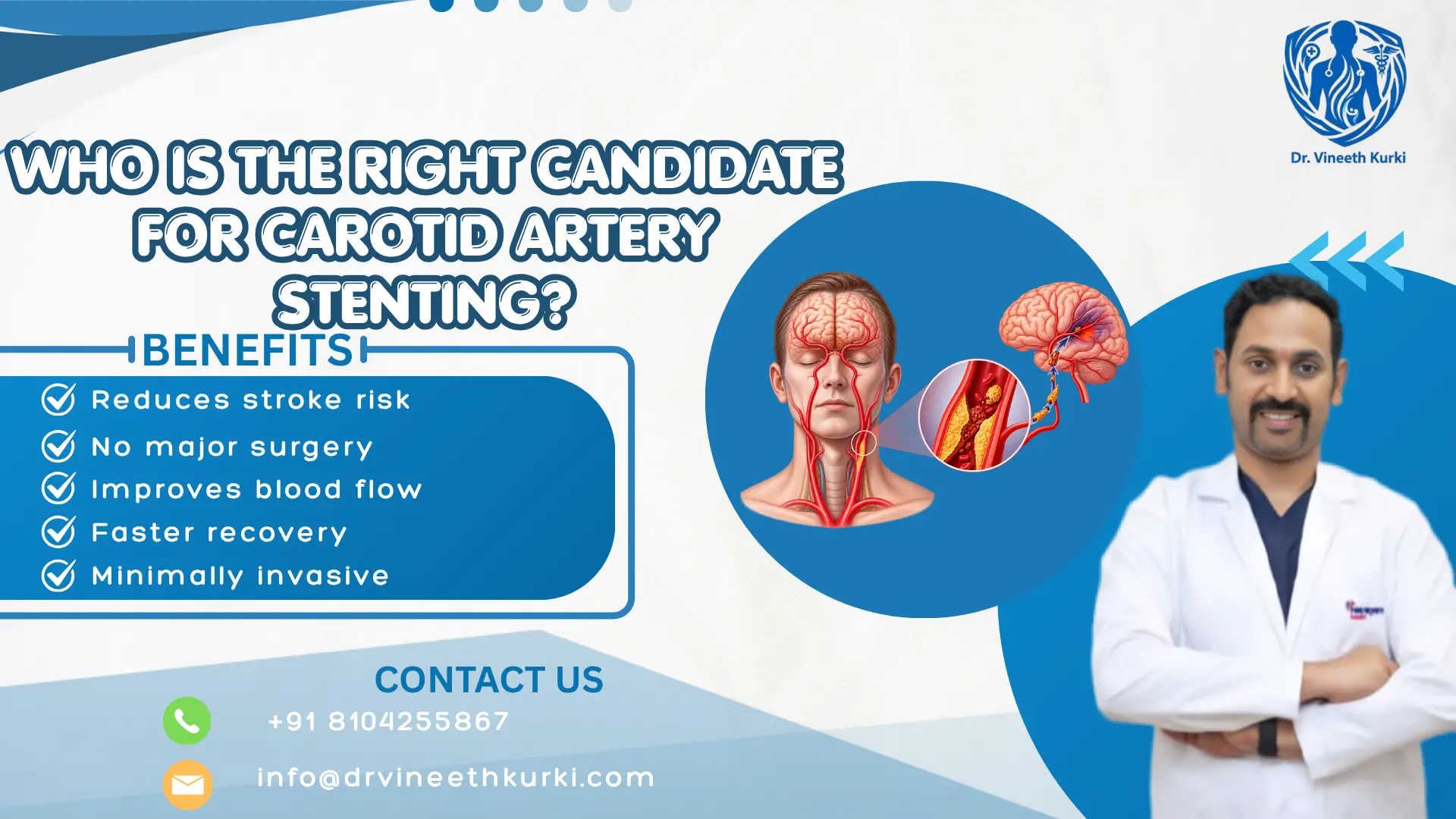
Carotid artery disease can develop silently, but when the arteries supplying blood to the brain become significantly narrowed, the risk of a transient ischemic attack (TIA) or stroke may increase. Carotid Artery Stenting is a minimally invasive treatment that can help restore blood flow through a narrowed carotid artery and, in carefully selected patients, reduce the risk of future stroke.
However, carotid stenting is not automatically suitable for everyone with carotid artery narrowing. The decision depends on the degree of stenosis, symptoms, age, overall health, vascular anatomy, previous treatments, and whether carotid endarterectomy or medical management may be a better option.
This is why evaluation by an experienced Carotid Artery Doctor is important before deciding on treatment.
Who Is Right for Carotid Artery Stenting? The answer is individual. Patients with severe narrowing who have experienced stroke-related symptoms, or selected patients in whom conventional surgery may carry greater risks, may be considered for the procedure after detailed evaluation.
Symptoms, Causes and Who May Need Carotid Artery Stenting
Symptoms of Carotid Artery Disease
Carotid artery narrowing may cause no symptoms during its early stages. Unfortunately, the first sign may sometimes be a TIA or stroke. Warning symptoms can include:
- Sudden weakness or numbness, particularly on one side of the body
- Sudden difficulty speaking or understanding speech
- Temporary or sudden loss of vision in one eye
- Sudden dizziness or loss of balance
- Difficulty walking or coordinating movements
- Sudden, severe headache without an obvious cause
These symptoms require urgent medical attention, even if they disappear after a few minutes because they may represent a TIA.
Causes and Risk Factors
The most common cause of carotid artery stenosis is atherosclerosis, in which fatty deposits and plaque accumulate within the arterial wall. Factors that can increase the risk include:
- High blood pressure
- High cholesterol
- Diabetes
- Smoking
- Obesity
- Physical inactivity
- Increasing age
- Previous cardiovascular disease
- Family history of vascular disease
Managing these risk factors remains an important part of stroke prevention, regardless of whether a procedure is ultimately recommended.
Who Is a Potential Candidate?
Who Is Right for Carotid Artery Stenting? In general, the procedure may be considered for carefully selected people with significant carotid stenosis, particularly when they have had a TIA or stroke related to the affected artery. Severe narrowing, commonly around 70% or more in appropriate clinical circumstances, is an important consideration.
Stenting may also be considered when carotid endarterectomy—the surgical removal of plaque—is technically difficult or carries increased risk. Examples may include:
- Previous neck surgery
- Previous radiation treatment to the neck
- Significant medical conditions that increase surgical risk
- Recurrent narrowing after previous carotid endarterectomy
- Anatomical features that make open surgery challenging
The exact threshold and treatment choice should be individualized rather than based on the percentage of narrowing alone. The American Heart Association notes that the choice between carotid endarterectomy and stenting should take into account patient comorbidities and vascular anatomy.
Diagnosis and Treatment/Procedure
Diagnosis
Before recommending Carotid Artery Stenting, a specialist needs to establish how severe the narrowing is and whether it is responsible for the patient’s symptoms.
Diagnostic evaluation may include:
Carotid Doppler ultrasound:
A non-invasive test that assesses blood flow and can estimate the degree of narrowing.
CT angiography (CTA):
Provides detailed images of the carotid arteries and surrounding vascular anatomy.
MR angiography (MRA):
Uses magnetic resonance imaging to evaluate blood vessels without conventional catheter angiography.
Neurological and clinical assessment:
The doctor will review previous TIAs, strokes, visual symptoms, medications, and cardiovascular risk factors.
The imaging results are particularly important because stenting requires suitable vascular anatomy. A multidisciplinary assessment may be appropriate when the best treatment option is uncertain.
What Happens During Carotid Artery Stenting?
Who Is Right for Carotid Artery Stenting? Patients who are considered appropriate after clinical and imaging assessment may undergo the procedure through a catheter-based approach rather than an open neck operation.
The procedure generally involves:
- Vascular access: A small catheter is introduced through an artery, commonly through the groin or another suitable access site.
- Catheter navigation: The catheter is carefully guided toward the narrowed carotid artery using real-time imaging.
- Protection against plaque embolization: When appropriate, an embolic protection device may be used to reduce the chance of plaque particles reaching the brain.
- Balloon angioplasty: A balloon may be used to widen the narrowed segment.
- Stent placement: A small mesh tube is positioned across the narrowed area to help maintain the artery’s opening.
- Final imaging: Blood flow is checked before the catheter is removed.
Mayo Clinic describes carotid angioplasty and stenting as a treatment that may be used when traditional carotid surgery is not possible or carries excessive risk in selected patients.
Carotid Artery Stenting vs Carotid Endarterectomy
Both procedures can be used to treat significant carotid artery disease, but they are performed differently.
| Feature | Carotid Artery Stenting | Carotid Endarterectomy |
| Approach | Catheter-based | Open surgical procedure |
| Neck incision | Usually avoided | Required |
| Plaque treatment | Artery is widened and supported with a stent | Plaque is surgically removed |
| Recovery | Generally less invasive | More surgical recovery |
| Suitable for | Selected patients based on anatomy and risk | Often preferred in appropriate surgical candidates |
| Decision | Individualized | Individualized |
Neither approach is universally better. For some patients, endarterectomy may provide the preferred balance of benefits and risks, while others may be better suited to stenting.
Benefits and Possible Risks
Who Is Right for Carotid Artery Stenting? Appropriate candidates may benefit from restoring blood flow through a significantly narrowed carotid artery while avoiding a traditional open surgical approach.
Potential advantages include:
- Minimally invasive treatment
- No large surgical incision in the neck
- Improved blood flow through the treated artery
- Potential reduction in future stroke risk in appropriately selected patients
- Useful option when surgery is difficult or considered higher risk
- Potentially shorter recovery compared with open surgery
However, carotid stenting is not risk-free. Possible complications include stroke or TIA, bleeding, blood-vessel injury, restenosis, or reactions related to the procedure or contrast material.
The goal is therefore not simply to perform a procedure, but to determine whether the expected benefit outweighs the potential risk for that particular patient.
Recovery, Benefits and Follow-Up
Recovery After Carotid Artery Stenting
Recovery varies depending on the patient’s overall health, the access site used, and whether there were any complications.
After the procedure, patients are usually monitored for changes in blood pressure, heart rate, neurological status, and the access site. The treating team may prescribe antiplatelet medication to help prevent clot formation around the stent.
Patients should take prescribed medications exactly as directed and attend follow-up appointments. Long-term stroke prevention also involves controlling blood pressure and cholesterol, managing diabetes when present, avoiding smoking, maintaining a healthy weight, and staying physically active as medically appropriate.
Any new symptoms such as facial drooping, weakness, difficulty speaking, sudden vision changes, severe dizziness, or loss of coordination require immediate medical evaluation.
Why Choosing the Right Specialist Matters
Who Is Right for Carotid Artery Stenting? Determining the answer requires more than looking at an ultrasound report. An experienced Carotid Artery Doctor considers the patient’s symptoms, imaging, medical history, anatomy, age, surgical risk, and alternative treatment options before recommending intervention.
Dr. Vineeth Kurki is an experienced Interventional Radiologist in Bangalore, specializing in minimally invasive, image-guided procedures. His expertise includes advanced endovascular and vascular interventions designed to treat a range of conditions without the need for major open surgery.
With a focus on precision-guided treatments, Dr. Vineeth Kurki evaluates each patient’s condition, medical history, and imaging results to recommend an appropriate treatment approach. His areas of interventional radiology practice include vascular interventions, image-guided procedures, and minimally invasive treatments aimed at improving patient outcomes and supporting faster recovery.
Patients looking for expert evaluation for conditions requiring Carotid Artery Stenting and other minimally invasive vascular procedures can consult Dr. Vineeth Kurki for personalized treatment guidance.
Frequently Asked Questions
1. Who Is Right for Carotid Artery Stenting?
Who Is Right for Carotid Artery Stenting? Patients with significant carotid artery narrowing, particularly those with recent TIA or stroke symptoms, may be candidates. Stenting can also be considered when carotid surgery is technically difficult or carries higher risk. The final decision requires individualized assessment.
2. Is Carotid Artery Stenting suitable for everyone with carotid blockage?
No. Some patients may benefit more from carotid endarterectomy or intensive medical treatment. Age, anatomy, symptoms, severity of stenosis, and overall health all influence the decision.
3. What degree of carotid blockage may require stenting?
Severe stenosis, particularly around 70% or greater in appropriate symptomatic or selected high-risk situations, may lead to consideration of revascularization. The percentage alone does not determine treatment.
4. Is carotid stenting a surgery?
It is generally considered a minimally invasive, catheter-based procedure rather than traditional open surgery. A catheter is used to deliver and position the stent inside the narrowed artery.
5. Is carotid stenting better than carotid endarterectomy?
Not necessarily. Both treatments have specific advantages and risks. Current guidance emphasizes selecting the treatment according to patient characteristics, comorbidities and vascular anatomy.
6. How long does recovery take after carotid stenting?
Recovery differs from patient to patient. Many patients can resume routine activities relatively quickly, but the treating team will provide individualized instructions regarding activity, medications and follow-up.
7. What tests are required before carotid stenting?
Doctors may use carotid Doppler ultrasound, CT angiography, MR angiography and other clinical assessments to understand the severity and anatomy of the narrowing and determine whether intervention is appropriate.
8. Can carotid artery disease be treated without stenting?
Yes. Depending on the severity and symptoms, treatment may include lifestyle changes, cholesterol-lowering medication, blood-pressure control, diabetes management, antiplatelet therapy, carotid endarterectomy, or another intervention.
9. What symptoms should prompt urgent medical attention?
Sudden facial or limb weakness, speech difficulty, sudden vision loss, severe dizziness, loss of balance, or other signs of stroke require emergency medical assessment. Even symptoms that resolve quickly can indicate a TIA.
10. Why should I consult a Carotid Artery Doctor?
A Carotid Artery Doctor can evaluate the severity and location of the narrowing, review your symptoms and scans, assess procedural risks, and help determine whether stenting, surgery, or medical management is the most appropriate approach.
Conclusion
Who Is Right for Carotid Artery Stenting? There is no single answer that applies to every patient. The procedure is generally considered for carefully selected patients with significant carotid artery stenosis, especially when symptoms suggest that the narrowing has contributed to a TIA or stroke. It can also be valuable when conventional carotid surgery is difficult or carries increased risk.
The most important step is obtaining an expert evaluation before making a treatment decision. Appropriate imaging, assessment of stroke risk, understanding of vascular anatomy, and comparison with medical therapy or carotid endarterectomy all contribute to a safer, more personalized treatment plan.
If you have been diagnosed with carotid artery narrowing, experienced a TIA or stroke, or have been advised to consider a stent, Dr. Vineeth Kurki, Interventional Radiologist in Bengaluru, can help evaluate your condition and discuss suitable minimally invasive treatment options. His interventional radiology practice includes image-guided minimally invasive procedures, with professional work spanning vascular and other interventional applications.
Book an appointment with Dr. Vineeth Kurki today for a personalized evaluation and expert guidance on whether Carotid Artery Stenting is appropriate for you. Do not ignore sudden neurological symptoms—seek emergency medical care immediately if they occur.