
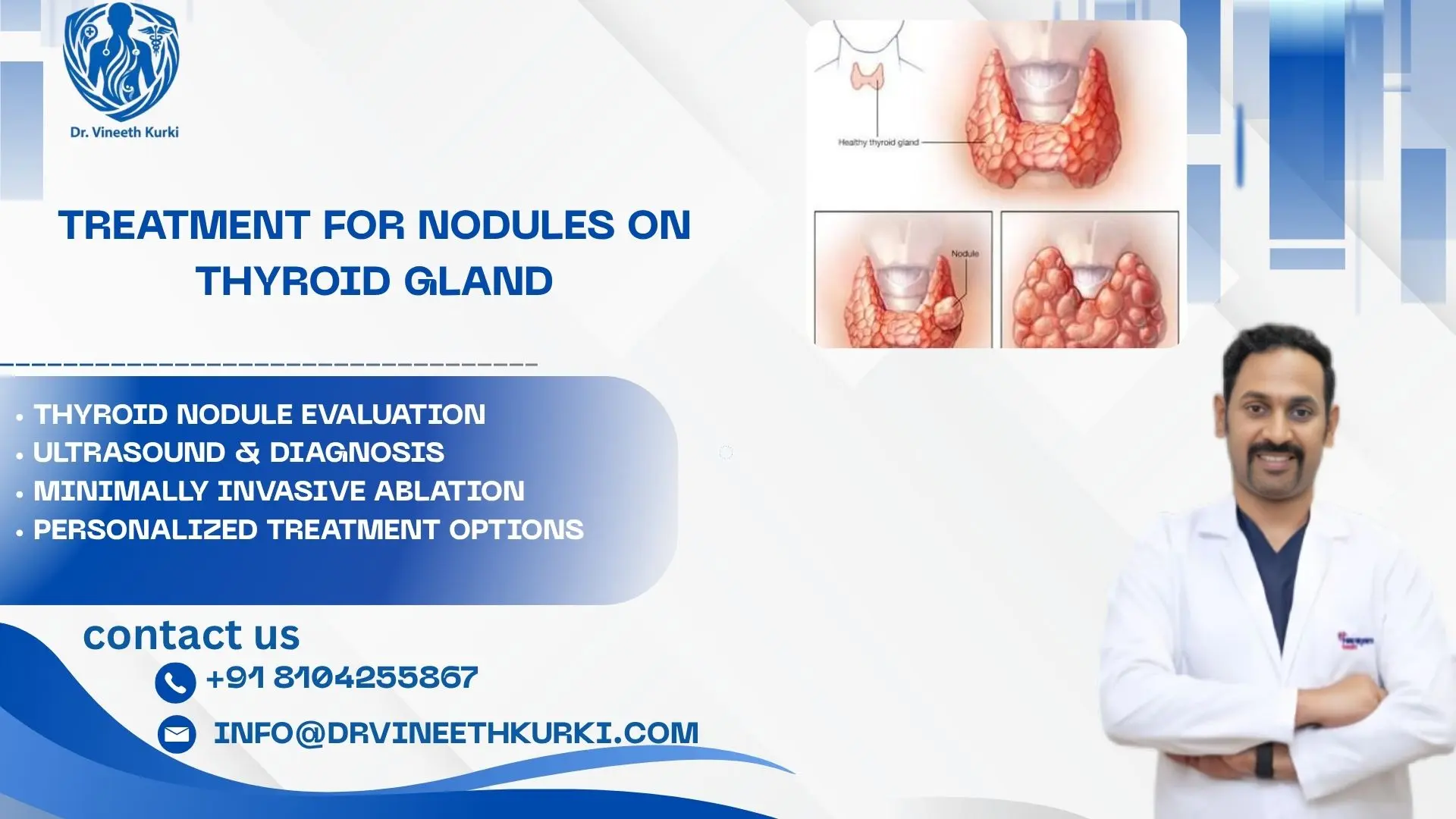
Thyroid nodules are lumps that develop within the thyroid gland. Although many thyroid nodules are benign, some can cause neck discomfort, difficulty swallowing, visible swelling, or pressure-related symptoms. Treatment depends on the nodule’s size, ultrasound features, biopsy results, symptoms, and thyroid function.
Treatment for nodules on thyroid gland may include regular monitoring, medication for specific thyroid conditions, surgery, or minimally invasive procedures such as thyroid radiofrequency ablation (Thyroid RFA). For selected patients with benign thyroid nodules, Thyroid RFA can reduce nodule volume without removing the thyroid gland.
At Mazumdar Shaw Medical Center, Narayana Health City, Bommasandra, Bengaluru, patients can consult Dr Vineeth Kurki, Endovascular Interventional Radiologist in Bangalore, to discuss suitable image-guided treatment options. The appropriate approach depends on an individual assessment rather than the nodule’s size alone.
What Are Thyroid Nodules? Symptoms, Causes and Diagnosis
What are thyroid nodules?
Thyroid nodules are solid or fluid-filled lumps that form inside the thyroid gland, located at the front of the neck. They are common and may be discovered during a physical examination, ultrasound scan, or investigation for another medical concern.
Most thyroid nodules are benign, but appropriate assessment is necessary to determine whether treatment or monitoring is required. People researching Treatment for nodules on thyroid gland should understand that not every nodule requires an operation or an ablation procedure.
Common symptoms of thyroid nodules
Small thyroid nodules often do not cause noticeable symptoms. Larger nodules may produce:
- A visible lump or swelling at the front of the neck
- A feeling of pressure in the throat
- Difficulty swallowing
- Discomfort when wearing tight collars
- Voice changes in certain cases
- A sensation of something being stuck in the throat
Thyroid nodules do not always affect hormone production. However, some nodules are associated with an overactive thyroid, which can cause palpitations, sweating, tremors, or unexplained weight changes.
Seek prompt medical assessment if a lump grows rapidly, and urgent assessment if breathing becomes difficult.
What causes thyroid nodules?
Several factors may contribute to thyroid nodule development:
- Benign tissue growth: Non-cancerous growths can form within the thyroid gland.
- Thyroid cysts: Fluid-filled spaces may develop within thyroid tissue.
- Multinodular goitre: Multiple nodules can enlarge the thyroid gland.
- Thyroid inflammation: Conditions affecting the thyroid may alter its structure.
- Iodine-related factors: Iodine deficiency can contribute to thyroid enlargement in some populations.
- Thyroid cancer: A smaller proportion of nodules are malignant and require a different management approach.
The cause cannot be determined from symptoms alone. A clinical evaluation is essential.
How are thyroid nodules diagnosed?
Before recommending Treatment for nodules on thyroid gland, the doctor assesses the nodule and the patient’s overall thyroid health.
Common investigations include:
- Thyroid ultrasound: Evaluates nodule size, composition, margins, and other features that help determine risk.
- Thyroid function tests: Blood tests, including TSH, help assess how well the thyroid is functioning.
- Fine-needle aspiration (FNA): A small needle collects cells from the nodule when indicated.
- Additional investigations: Depending on the findings, further testing may be required, particularly for suspicious nodules or abnormal thyroid function.
A biopsy result is important when considering Thyroid RFA. Nodules with suspicious or malignant findings require appropriate specialist evaluation rather than routine treatment as benign nodules.
Non-Surgical Thyroid Treatment: How Thyroid RFA Works
What is Thyroid RFA?
Thyroid radiofrequency ablation (Thyroid RFA) is a minimally invasive, image-guided procedure that uses controlled heat to treat selected thyroid nodules. It is performed using a specialised electrode inserted through the skin, usually under ultrasound guidance.
The heat causes targeted tissue damage within the nodule. Over time, the treated tissue shrinks and is gradually absorbed by the body.
For suitable patients, this approach offers an alternative to thyroid surgery. However, it does not remove the nodule immediately, and complete disappearance is not guaranteed.
Who may be suitable for Thyroid RFA?
Thyroid RFA may be considered for patients who have:
- Benign thyroid nodules causing pressure or swallowing discomfort
- Nodules producing visible neck swelling
- Cosmetic concerns related to an enlarged benign nodule
- Selected benign nodules that continue to cause symptoms
- A preference to explore a minimally invasive option instead of surgery
Eligibility depends on ultrasound findings, biopsy results, nodule characteristics, symptoms, and the patient’s medical history. Some nodules require repeat biopsy confirmation before ablation.
Important: Thyroid RFA is not a universal treatment for every thyroid nodule. Suspicious or malignant nodules, certain autonomously functioning nodules, and nodules with particular anatomical features may require a different treatment strategy.
How is the procedure performed?
The procedure generally follows these steps:
Step 1: Pre-procedure assessment
The doctor reviews ultrasound images, biopsy findings, thyroid function tests, medications, and medical history.
Step 2: Local anaesthesia
The treatment area is cleaned, and local anaesthesia is administered. Sedation may be used selectively.
Step 3: Ultrasound-guided electrode placement
A thin electrode is introduced into the nodule through the skin. Continuous ultrasound guidance helps the doctor direct treatment towards the intended tissue while monitoring nearby structures.
Step 4: Controlled ablation
Radiofrequency energy generates heat within the targeted tissue. The doctor adjusts treatment according to the nodule’s characteristics and its proximity to important structures.
Step 5: Post-procedure observation
The patient is monitored for discomfort, swelling, voice changes, or other immediate complications. Many patients return home on the same day, depending on their condition and the treating facility’s protocol.
How is non-surgical thyroid treatment different from medication?
Medication is useful for certain thyroid disorders, particularly when hormone production is abnormal. However, medication generally does not reliably eliminate a benign thyroid nodule causing pressure or cosmetic symptoms.
For patients seeking Treatment for nodules on thyroid gland, the decision between monitoring, medication, RFA, and surgery depends on the specific clinical problem. RFA targets the nodule itself, whereas medication may address hormone-related abnormalities.
Benefits, Recovery and RFA vs Surgery
Potential benefits of Thyroid RFA
When performed for an appropriate indication, Thyroid RFA may offer several advantages:
- No conventional surgical incision: The electrode is inserted through the skin using a small puncture.
- Thyroid tissue preservation: The procedure treats the targeted nodule without routinely removing the thyroid gland.
- Local anaesthesia: Many procedures can be performed without general anaesthesia.
- Shorter recovery: Patients may resume many routine activities sooner than after thyroid surgery.
- Gradual reduction in nodule size: The treated nodule can shrink over the following months.
- Avoidance of some surgery-related consequences: There is no routine surgical removal of thyroid tissue, although RFA still carries risks and does not eliminate the possibility of future treatment.
Results vary. Some nodules may require repeat ablation, and ongoing ultrasound follow-up is necessary.
What is the recovery period after Thyroid RFA?
Recovery depends on the size and location of the nodule, the extent of treatment, and the patient’s health.
Most patients experience mild soreness, tenderness, or temporary swelling around the treated area. Some may have bruising or discomfort when swallowing for a short period.
General recovery guidance includes:
- Follow the treating doctor’s instructions regarding medication and wound care.
- Avoid strenuous exercise until cleared by the treating team.
- Report increasing swelling, fever, significant pain, or new voice changes.
- Seek urgent medical attention for breathing difficulty or rapidly increasing neck swelling.
- Attend scheduled ultrasound and thyroid function follow-ups.
The nodule’s size typically decreases over several months rather than immediately. Long-term monitoring helps assess treatment response and identify regrowth.
Thyroid RFA vs thyroid surgery
| Feature | Thyroid RFA | Thyroid surgery |
| Approach | Image-guided, minimally invasive | Surgical removal of part or all of the thyroid |
| Anaesthesia | Usually local | Commonly general |
| Thyroid tissue | Targeted tissue is treated | Part or all of the gland may be removed |
| Recovery | Often shorter | Generally longer |
| Tissue examination | Does not provide a complete surgical specimen | Removed tissue can undergo histopathological examination |
| Suitability | Selected benign nodules and specific cases | Suspicious or malignant nodules and other appropriate indications |
Neither option is universally better. Surgery may be preferable when cancer is suspected, a nodule has concerning features, or its size or location makes ablation unsuitable. RFA may be appropriate for selected benign nodules when preserving thyroid tissue and avoiding conventional surgery are important considerations.
Factors that influence the treatment decision
The choice of Treatment for nodules on thyroid gland depends on several factors:
- Nodule size and volume
- Ultrasound appearance and biopsy findings
- Pressure symptoms or cosmetic concerns
- Thyroid hormone levels
- Position of the nodule near the windpipe, nerves, or other structures
- Previous thyroid treatment
- The patient’s overall health and treatment preferences
An individual consultation is necessary to discuss the expected benefits, risks, alternatives, and follow-up requirements.
Frequently Asked Questions About Treatment for nodules on thyroid gland
1. Is Thyroid RFA a non-surgical treatment?
Yes. Thyroid RFA is a minimally invasive procedure that treats selected nodules through a small skin puncture, generally under ultrasound guidance. It does not require conventional surgical removal of the thyroid gland.
2. Can all thyroid nodules be treated with RFA?
No. RFA is primarily used for selected benign nodules that cause symptoms or cosmetic concerns. Nodules with suspicious or malignant findings require specialist assessment and may need surgery or another treatment.
3. Does Thyroid RFA affect thyroid hormone levels?
Thyroid RFA aims to preserve the surrounding thyroid tissue. Many patients maintain thyroid function, but individual outcomes vary. Thyroid function monitoring remains important after treatment.
4. Is Thyroid RFA painful?
Local anaesthesia is generally used to reduce discomfort. Patients may experience pressure, mild pain, or temporary soreness during or after the procedure. The experience varies between individuals.
5. How long does a thyroid nodule take to shrink after RFA?
Shrinkage occurs gradually over weeks and months. The degree of reduction depends on the nodule’s initial size, composition, and response to treatment. Follow-up ultrasound is used to assess progress.
6. Is RFA better than thyroid surgery?
Neither treatment is best for every patient. RFA may suit selected patients with benign symptomatic nodules, while surgery may be more appropriate for suspicious nodules, confirmed cancer, or certain large or complex growths.
7. What is the cost of Thyroid RFA in Bangalore?
The cost depends on the nodule’s size, number of nodules, investigations, procedural requirements, hospital charges, and follow-up care. A reliable estimate should be provided after an individual clinical assessment rather than assuming a fixed price.
8. Where can I consult a specialist for non-surgical thyroid nodule treatment in Bangalore?
Patients can enquire about assessment with Dr Vineeth Kurki, Endovascular Interventional Radiologist in Bangalore, at Mazumdar Shaw Medical Center, Narayana Health City, Bommasandra Industrial Area, Bengaluru, Karnataka 560099.
9. Can thyroid nodules return after RFA?
A treated nodule may regrow or show incomplete volume reduction. Some patients may require repeat ablation or another treatment. Regular clinical and ultrasound follow-up helps identify these changes.
Conclusion
Treatment for nodules on the thyroid gland should be selected according to the nodule’s clinical features, biopsy results, symptoms, and the patient’s individual needs. Monitoring may be sufficient for many benign nodules, while others may benefit from medication, Thyroid RFA, or surgery.
For suitable patients, Thyroid RFA offers a minimally invasive option that can reduce benign thyroid nodule volume while preserving much of the surrounding thyroid tissue. However, appropriate diagnosis and specialist assessment are essential before deciding on treatment.
If you are experiencing neck swelling, throat pressure, or difficulty swallowing, arrange a medical evaluation to understand your options for thyroid treatment in Bangalore.
Book an appointment for a thyroid nodule assessment
Consult Dr Vineeth Kurki – Endovascular Interventional Radiologist in Bangalore to discuss whether an image-guided, non-surgical treatment approach may be appropriate for your condition.
Location: Mazumdar Shaw Medical Center, Narayana Health City, Bommasandra Industrial Area, Bommasandra, Karnataka 560099.
Appointment contact: +918104255867
One thought on “Thyroid Nodules”