
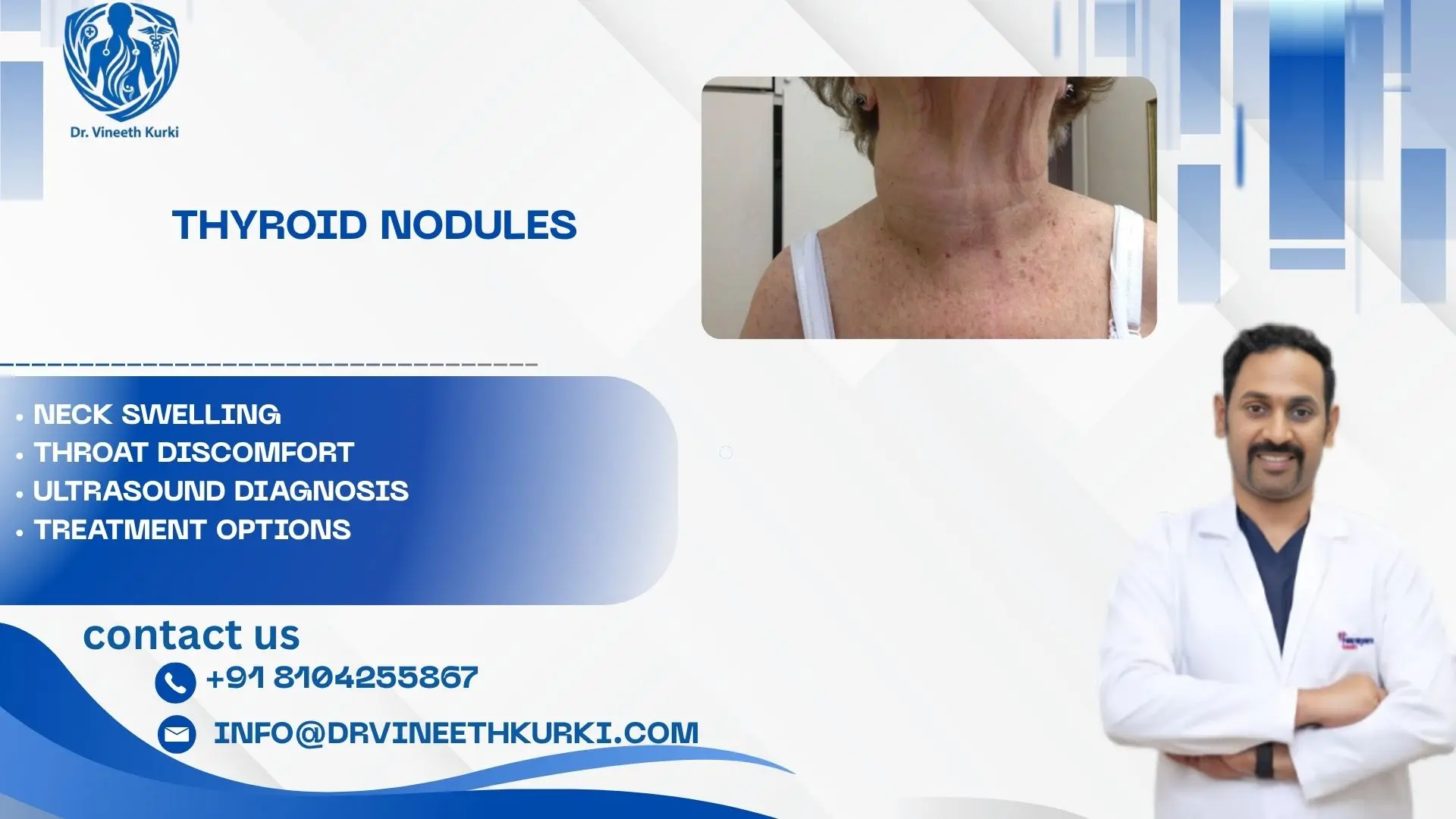
Thyroid nodules are lumps that develop within the thyroid gland, a small, butterfly-shaped gland located at the front of the neck.They are common, and many are benign and do not require immediate treatment. However, some thyroid nodules can cause neck discomfort, difficulty swallowing, visible swelling, or changes in thyroid hormone levels. A small proportion may be cancerous, making appropriate evaluation important.
Understanding thyroid nodules, their symptoms, causes, diagnosis, and treatment options can help patients make informed decisions about their health. Depending on the type of nodule, treatment may involve regular monitoring, medication for a specific thyroid condition, surgery, or minimally invasive procedures such as radiofrequency ablation (RFA) for selected benign nodules.
For patients seeking thyroid nodule evaluation in Bengaluru, understanding the available options is a useful first step. Dr. Vineeth Kurki, an endovascular interventional radiologist in Bangalore, is associated with Mazumdar Shaw Medical Center, Narayana Health City, Bommasandra. Patients should discuss their diagnosis and treatment suitability with the appropriate specialist.
Thyroid Nodules: Symptoms, Causes and Treatment Guide (2026) — Understanding the Condition
What Are Thyroid Nodules?
Thyroid nodules are abnormal growths of tissue or fluid-filled areas that develop within the thyroid gland. They may occur as a single lump or as multiple nodules. Some are solid, others contain fluid, and some have both solid and cystic components.
Most thyroid nodules are noncancerous. Many are discovered during a routine medical examination or an imaging test performed for another reason. Their size can range from very small nodules that cannot be felt to larger growths that create visible neck swelling.
The presence of a thyroid nodule does not automatically mean that treatment is necessary. Doctors consider its appearance on ultrasound, biopsy findings when indicated, thyroid function, size, growth pattern, and any symptoms before recommending management.
What Are the Common Symptoms of Thyroid Nodules?
Many thyroid nodules do not cause noticeable symptoms. When symptoms occur, they may include:
- A lump or swelling at the front of the neck.
- A feeling of pressure or tightness around the throat.
- Difficulty swallowing food or liquids.
- Discomfort when wearing tight collars.
- Hoarseness or persistent changes in the voice.
- Breathing discomfort when a large nodule presses on the airway.
- Symptoms of an overactive thyroid, such as a rapid heartbeat, tremor, sweating, or unexplained weight loss, in some patients.
These symptoms do not necessarily indicate cancer. However, a growing neck lump, persistent hoarseness, or difficulty swallowing warrants medical assessment. Breathing difficulty requires urgent evaluation.
What Causes Thyroid Nodules?
The exact cause depends on the type of nodule. Several factors may contribute:
- Benign thyroid growths: Noncancerous tissue growths can form within the gland.
- Thyroid cysts: Fluid-filled areas may develop within the thyroid.
- Colloid nodules: These are associated with normal components of thyroid tissue.
- Thyroid inflammation: Conditions such as Hashimoto’s thyroiditis can affect the gland’s structure.
- Iodine deficiency: Inadequate iodine intake can contribute to thyroid enlargement in some populations.
- Thyroid adenomas: These are usually benign growths that can sometimes produce excess thyroid hormones.
- Thyroid cancer: A minority of nodules are malignant and require specific evaluation and treatment.
Age, family history, previous radiation exposure to the head or neck, and certain inherited conditions can influence the risk of thyroid cancer. However, most thyroid nodules are not cancerous.
When Should You Seek Medical Advice?
Arrange a medical assessment if you notice a new neck lump, an enlarging thyroid nodule, or persistent throat pressure.
Seek prompt evaluation if the lump grows quickly, is associated with persistent voice changes, or causes difficulty swallowing. Sudden or severe breathing difficulty requires emergency care.
An accurate diagnosis is essential before choosing treatment.
Thyroid Nodules: Symptoms, Causes and Treatment Guide (2026) — Diagnosis and Treatment Options
How Are Thyroid Nodules Diagnosed?
Evaluation usually involves a clinical examination, blood tests, and imaging. Additional investigations depend on the nodule’s characteristics and the patient’s medical history.
1. Clinical examination
The doctor examines the neck and asks about symptoms, family history, previous thyroid conditions, and any changes in the lump.
2. Thyroid function blood tests
A thyroid-stimulating hormone (TSH) test is commonly performed. Depending on the results, additional tests such as free T4 may be recommended. These tests assess thyroid function but cannot independently determine whether a nodule is cancerous.
3. Thyroid ultrasound
Ultrasound assesses the nodule’s size, composition, margins, shape, and other features that help determine whether a biopsy is needed. It also helps identify suspicious lymph nodes in the neck.
4. Fine-needle aspiration biopsy
A fine-needle aspiration (FNA) biopsy collects cells from the nodule for laboratory examination when indicated. The results help determine whether the nodule is benign, suspicious, malignant, or inconclusive.
5. Additional imaging or testing
A thyroid scan may be recommended when TSH is low to determine whether a nodule is producing excess hormone. Further testing is guided by the initial findings.
The diagnostic process helps establish whether the nodule needs monitoring, additional testing, or treatment.
What Are the Treatment Options for Thyroid Nodules?
Treatment depends on the diagnosis rather than size alone.
Active monitoring: Small, benign, asymptomatic nodules may require only periodic clinical assessment and ultrasound. Follow-up frequency depends on the ultrasound pattern and clinical findings.
Medication: Medicines may be prescribed for particular thyroid disorders, such as an overactive thyroid or hypothyroidism. Thyroid hormone suppression is not routinely recommended simply to shrink a benign nodule.
Radiofrequency ablation (RFA): This minimally invasive procedure uses heat delivered through a specialised needle to reduce the volume of selected benign thyroid nodules over time.
Surgery: Thyroid surgery may be recommended for suspicious or cancerous nodules, significant compression symptoms, certain large or growing nodules, or other specific clinical indications.
Not every thyroid nodule needs treatment, and not every patient is suitable for RFA. A specialist should establish the diagnosis before recommending a procedure.
How Does Radiofrequency Ablation Work?
Radiofrequency ablation is an image-guided procedure used to treat selected benign thyroid nodules, particularly when they cause pressure symptoms or cosmetic concerns.
During treatment, the clinician uses ultrasound guidance to position a specialised electrode within the nodule. Radiofrequency energy generates heat that gradually destroys targeted tissue. The body then absorbs the treated tissue over time, causing the nodule to shrink.
The procedure is generally performed under local anaesthesia by a suitably trained specialist. Patients are monitored after treatment, and many can return home the same day.
Potential benefits include:
- No conventional surgical incision.
- Preservation of most of the surrounding thyroid tissue.
- Potential reduction in nodule size and pressure symptoms.
- Usually a shorter initial recovery than conventional surgery.
- A lower likelihood of requiring lifelong thyroid hormone replacement solely because of the procedure than after total thyroidectomy.
However, RFA has limitations. The nodule does not disappear immediately, shrinkage varies, and some patients may need additional treatment. Risks include pain, bleeding, burns, and temporary or, rarely, persistent voice changes.
RFA is not a substitute for appropriate cancer treatment. Suspicious or malignant nodules require management according to their diagnosis.
Thyroid Nodules: Symptoms, Causes and Treatment Guide (2026) — Recovery, Benefits and Comparison
What Is Recovery Like After Thyroid Nodule RFA?
Recovery following thyroid RFA is generally relatively quick, although individual experiences vary.
First 24 hours: Mild neck soreness, tenderness, or swelling may occur. Follow the treating clinician’s instructions regarding medication and wound care.
First few days: Many patients return to routine activities within a day or two, depending on their comfort and the procedure performed. Strenuous activity should be resumed according to medical advice.
Following weeks and months: The treated nodule gradually decreases in volume. Pressure symptoms may improve as the nodule shrinks, but the speed and extent of improvement vary.
Follow-up ultrasound is important to assess the response to treatment and determine whether additional intervention is needed.
Seek urgent medical care for rapidly increasing neck swelling, breathing difficulty, or severe symptoms after a procedure.
RFA vs Surgery: What Is the Difference?
| Feature | Radiofrequency ablation | Thyroid surgery |
| Approach | Needle-based, image-guided procedure | Surgical removal of part or all of the thyroid |
| Incision | No conventional surgical incision | Surgical incision in the neck |
| Typical use | Selected benign nodules | Cancer, suspicious nodules, compression, or other indications |
| Recovery | Usually shorter initial recovery | Recovery varies with the extent of surgery |
| Thyroid tissue | Most thyroid tissue is preserved | Some or all thyroid tissue may be removed |
| Hormone replacement | Usually not required solely because of RFA | May be required, particularly after total thyroidectomy |
| Repeat treatment | Sometimes required | Depends on diagnosis and surgical findings |
Neither treatment is universally better. The appropriate choice depends on the biopsy and ultrasound results, symptoms, nodule characteristics, patient preferences, and specialist assessment.
What Factors Affect Thyroid Nodule Treatment Cost?
The cost of thyroid nodule evaluation and treatment in Bengaluru varies according to the individual case. Important factors include:
- Consultation and specialist fees.
- Ultrasound and other diagnostic tests.
- Whether a biopsy or additional testing is required.
- The number, size, and characteristics of the nodules.
- Whether monitoring, RFA, or surgery is recommended.
- Hospital facilities, anaesthesia, and procedure-related materials.
- Follow-up appointments and any additional treatment.
Patients should request an individual estimate after diagnosis rather than relying on a general online price.
Finding Thyroid Nodule Care in Bengaluru
Patients looking for thyroid nodule treatment near me in Bengaluru should consider the availability of appropriate ultrasound assessment, biopsy services, experienced specialists, and follow-up care.
Dr. Vineeth Kurki is an endovascular interventional radiologist associated with Mazumdar Shaw Medical Center, Narayana Health City, Bommasandra, Karnataka. Patients considering image-guided thyroid procedures should confirm the clinician’s specific experience with thyroid ablation and discuss whether their diagnosis is suitable for this approach.
Thyroid Nodules: Symptoms, Causes and Treatment Guide (2026) — FAQs and Conclusion
Frequently Asked Questions
1. Are thyroid nodules usually cancerous?
No. Most thyroid nodules are benign. Ultrasound features, medical history, and biopsy results when indicated help determine whether further investigation is necessary.
2. Can thyroid nodules disappear without treatment?
Some cystic nodules may decrease in size, while many benign nodules remain stable. Others may grow slowly. Regular monitoring is appropriate when recommended by the treating clinician.
3. Can thyroid nodules be treated without surgery?
Yes. Selected benign nodules can be monitored or treated using minimally invasive methods such as RFA when symptoms or cosmetic concerns justify intervention. Other nodules may require surgery, particularly when cancer is suspected or confirmed.
4. Does every thyroid nodule require a biopsy?
No. The decision depends on ultrasound characteristics, size, clinical risk factors, and applicable guidelines. Some nodules can be monitored without immediate biopsy.
5. Is radiofrequency ablation safe for thyroid nodules?
RFA is an established treatment for selected benign nodules, but it carries potential risks. Proper diagnosis, operator experience, ultrasound guidance, and follow-up are important for safe care.
6. How long does thyroid RFA take to work?
The nodule generally shrinks gradually over several months. Symptom improvement depends on the original nodule size, its characteristics, and the treatment response.
7. Can thyroid nodules affect breathing or swallowing?
Yes. Larger nodules may press on nearby structures and cause swallowing difficulty, throat pressure, or breathing symptoms. These symptoms should be medically assessed.
8. Can thyroid nodules affect hormone levels?
Some nodules produce excess thyroid hormones, leading to hyperthyroidism. Many do not affect hormone production, so blood tests are useful during evaluation.
9. Where can I get thyroid nodule treatment in Bengaluru?
Consult an appropriately qualified thyroid specialist or an interventional radiologist with relevant thyroid ablation expertise. The treating clinician can review your reports and explain suitable options.
Conclusion
Thyroid nodules are common, and most are benign. Nevertheless, an appropriate evaluation is important to determine the nodule’s nature and whether treatment is necessary.
Thyroid Nodules: Symptoms, Causes and Treatment Guide (2026) highlights why diagnosis should come before treatment. Options range from observation to RFA and surgery, depending on the clinical findings. There is no single treatment suitable for every patient.
If you have a thyroid lump, persistent neck pressure, or difficulty swallowing, seek medical assessment rather than relying on symptoms alone.
Book a Consultation
For patients exploring thyroid nodule assessment or minimally invasive treatment options in Bengaluru, a specialist consultation can help clarify the diagnosis and next steps.
- Doctor: Dr. Vineeth Kurki – Endovascular Interventional Radiologist
- Location: Mazumdar Shaw Medical Center, Narayana Health City, Bommasandra Industrial Area, Bommasandra, Karnataka 560099
- Phone: +918104255867
One thought on “Thyroid nodules – Symptoms and causes”