
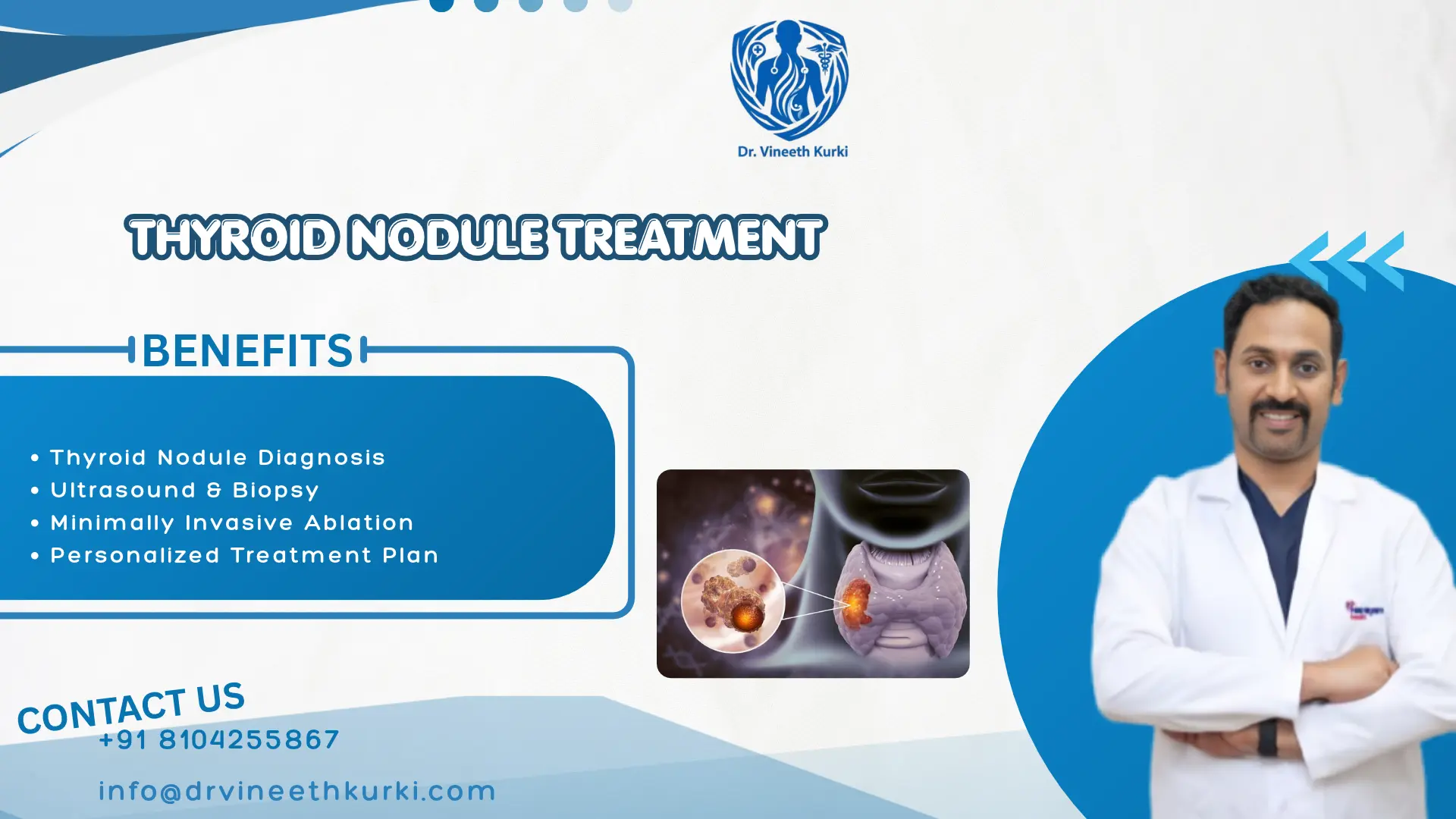
A thyroid nodule is a lump that develops within the thyroid gland, a small, butterfly-shaped gland located at the front of the neck. Many thyroid nodules are benign and do not require immediate treatment. However, some may grow larger, cause swallowing discomfort, affect the voice, or require further investigation to rule out thyroid cancer.
Understanding the available options for thyroid nodule treatment can help patients make informed decisions about their healthcare. Depending on the nodule’s size, ultrasound appearance, biopsy findings, thyroid hormone levels, and symptoms, treatment may involve regular monitoring, medication for a specific thyroid condition, minimally invasive ablation, or surgery.
For patients seeking thyroid care in Bangalore, an individual assessment is important because not every thyroid nodule requires the same approach. This guide explains the symptoms, causes, diagnostic tests, treatment options, benefits, recovery, and factors that influence treatment decisions.
1. Understanding Thyroid Nodules: Symptoms, Causes and Diagnosis
What Is a Thyroid Nodule?
A thyroid nodule is an abnormal growth of tissue or a fluid-filled cyst within the thyroid gland. Nodules can occur individually or in groups, and their size can range from a few millimetres to several centimetres.
Most thyroid nodules are non-cancerous. However, a healthcare professional may recommend further tests to determine their nature and assess whether treatment is necessary.
The right approach to Thyroid Nodule Treatment: A Complete Guide begins with understanding the type of nodule and its effect on the patient’s health. Some nodules remain stable for years, while others gradually increase in size and cause discomfort.
Common Symptoms of Thyroid Nodules
Many thyroid nodules do not cause noticeable symptoms and are discovered during a routine examination or imaging test. When symptoms occur, they may include:
- A visible lump or swelling at the front of the neck.
- A sensation of pressure or tightness in the throat.
- Difficulty swallowing food or liquids.
- Breathing discomfort, particularly when lying down, if a large nodule compresses nearby structures.
- Voice changes or persistent hoarseness.
- Neck discomfort associated with a growing nodule.
Some nodules produce excess thyroid hormones, which may cause symptoms such as a rapid heartbeat, sweating, tremors, anxiety, or unexplained weight loss. Other nodules may occur alongside an underactive thyroid.
Important: A rapidly enlarging lump, persistent hoarseness, difficulty breathing, or significant swallowing problems requires prompt medical assessment. Severe breathing difficulty warrants emergency care.
What Causes Thyroid Nodules?
The exact cause is not always identifiable. Several factors may contribute to thyroid nodule development:
- Thyroid tissue overgrowth: Certain areas of the gland grow more than usual.
- Colloid nodules: Benign growths associated with the normal substances stored in the thyroid.
- Thyroid cysts: Fluid-filled nodules that may develop within the gland.
- Thyroid inflammation: Conditions such as thyroiditis can affect thyroid tissue.
- Iodine deficiency: Insufficient iodine can contribute to thyroid enlargement in some populations.
- Multinodular goitre: Multiple nodules develop within an enlarged thyroid gland.
- Thyroid cancer: A smaller proportion of nodules are malignant and require a different treatment pathway.
A family history of thyroid cancer, previous radiation exposure to the head or neck, and certain inherited conditions may increase the risk of malignancy.
How Are Thyroid Nodules Diagnosed?
Accurate diagnosis helps determine whether observation, treatment, or further investigation is needed.
1. Clinical examination: The doctor examines the neck, assesses the lump, and reviews symptoms and medical history.
2. Thyroid function tests: Blood tests, including thyroid-stimulating hormone (TSH), help evaluate how well the gland functions. Additional hormone tests may be recommended.
3. Thyroid ultrasound: Ultrasound evaluates the nodule’s size, composition, margins, and other features that help estimate its risk of malignancy.
4. Fine-needle aspiration (FNA): A thin needle collects cells from a nodule when its ultrasound appearance and size indicate that biopsy is appropriate. The sample is examined by a pathologist.
5. Additional investigations: Depending on the findings, a thyroid scan, repeat biopsy, molecular testing, or specialist consultation may be recommended.
A structured assessment is the foundation of Thyroid Nodule Treatment: A Complete Guide, as the treatment plan must reflect both the nodule’s characteristics and the patient’s overall health.
2. Thyroid Nodule Treatment Options and Procedures
There is no single treatment suitable for every thyroid nodule. The choice depends on whether the nodule is benign or suspicious, whether it produces excess hormones, its size, the symptoms it causes, and the patient’s preferences.
1. Active Surveillance
Small, asymptomatic nodules with reassuring ultrasound and biopsy findings may not require immediate intervention.
Monitoring generally involves periodic clinical assessment and repeat ultrasound when indicated. The follow-up interval depends on the nodule’s risk pattern, size, and previous findings.
Active surveillance avoids unnecessary procedures while allowing doctors to identify significant changes over time.
2. Medication
Medication is useful in selected thyroid conditions, but it does not routinely eliminate benign thyroid nodules.
For example, medication may be prescribed for hypothyroidism or certain cases of hormone-producing nodules. Radioactive iodine may be considered for some overactive thyroid conditions.
Thyroid hormone suppression is not routinely recommended solely to shrink benign nodules because its potential risks may outweigh the benefits.
3. Radiofrequency Ablation (RFA)
Radiofrequency ablation is a minimally invasive, image-guided procedure that uses heat to reduce the volume of selected nodules.
It may be considered for appropriately evaluated, symptomatic benign thyroid nodules, particularly when the patient wants to avoid surgery or preserve thyroid tissue.
How the procedure works:
- The specialist reviews the ultrasound and confirms that the nodule is suitable for ablation.
- Local anaesthesia is generally administered.
- Using ultrasound guidance, the specialist inserts a thin ablation electrode into the targeted nodule.
- Radiofrequency energy generates heat within the selected tissue.
- The treated tissue gradually shrinks over the following months, reducing the nodule’s volume and potentially relieving pressure symptoms.
The procedure does not remove the nodule immediately. Its size decreases gradually, and additional treatment may occasionally be necessary.
4. Other Ablation Techniques
Ethanol ablation may be suitable for selected recurrent, predominantly cystic thyroid nodules. Other thermal techniques, such as laser or microwave ablation, may be available in specialist centres.
The appropriate method depends on the nodule’s composition, location, size, and clinical findings. These techniques are not interchangeable in every case.
5. Thyroid Surgery
Surgery may be recommended when a nodule is suspicious or confirmed to be malignant, causes substantial compression, has concerning growth, or cannot be appropriately managed with other methods.
Depending on the clinical situation, the surgeon may remove part of the thyroid gland or the entire gland.
Surgery provides tissue for detailed examination and may be necessary for cancer treatment. However, it involves an operation and carries risks such as bleeding, voice changes due to nerve injury, and changes in calcium regulation after certain procedures. Thyroid hormone replacement may be required following surgery, particularly after total thyroid removal.
Who May Be Suitable for Thyroid Ablation?
A patient may be considered for ablation when:
- The nodule is confirmed to be benign according to appropriate diagnostic criteria.
- It causes pressure, discomfort, cosmetic concerns, or other significant symptoms.
- The ultrasound findings support a suitable treatment approach.
- The patient prefers a minimally invasive alternative when clinically appropriate.
Ablation is not a substitute for the recommended cancer evaluation or surgery when malignancy is suspected or confirmed. Some nodules require additional assessment before treatment can be considered.
For people exploring Thyroid Nodule Treatment: A Complete Guide, a specialist consultation helps establish whether observation, ablation, or surgery is the most appropriate option.
3. Benefits, Recovery, Comparison and Treatment Cost Factors
Benefits of Minimally Invasive Thyroid Ablation
For carefully selected patients, thyroid ablation may offer several benefits:
- No large surgical incision: The procedure uses a small needle entry point.
- Thyroid tissue preservation: Much of the normal thyroid gland remains intact.
- Potential symptom relief: Reducing nodule volume can improve pressure and swallowing discomfort.
- Limited recovery time: Many patients return to routine activities relatively quickly.
- No general anaesthesia in many cases: RFA is commonly performed under local anaesthesia.
- Gradual cosmetic improvement: A visible neck lump may become less noticeable as the nodule shrinks.
Results vary from patient to patient. Ablation can cause complications, including pain, bleeding, voice changes, and, occasionally, changes in thyroid function. Continued follow-up remains important.
What Is the Recovery Time After Thyroid Ablation?
Recovery depends on the procedure, the nodule’s size, and the patient’s health.
Many patients can return to light daily activities within a day or two after uncomplicated RFA, following the treating specialist’s instructions. Mild neck soreness, tenderness, or swelling may occur temporarily.
The reduction in nodule size takes longer than the initial recovery. Follow-up ultrasound examinations are used to assess the response over subsequent months.
Patients should seek medical attention for increasing neck swelling, difficulty breathing, significant swallowing difficulty, fever, or new voice changes.
Thyroid Ablation vs Surgery: What Is the Difference?
| Feature | Thyroid ablation | Thyroid surgery |
| Approach | Needle-based, image-guided | Operative removal of thyroid tissue |
| Anaesthesia | Usually local for RFA | Often general anaesthesia |
| Incision | Small needle entry point | Surgical incision |
| Tissue preservation | Preserves much of the thyroid | Depends on the extent of removal |
| Recovery | Often shorter | Generally longer |
| Tissue examination | Does not provide a complete surgical specimen | Provides removed tissue for pathology |
| Best suited for | Selected benign, symptomatic nodules | Cancer, suspicious nodules, or other surgical indications |
Neither treatment is universally better. The appropriate option depends on diagnosis, symptoms, risk factors, and individual treatment goals.
What Factors Affect Thyroid Nodule Treatment Cost?
The cost of thyroid nodule treatment varies by hospital, specialist, procedure, and individual medical requirements. An accurate estimate should be provided only after an appropriate assessment.
Factors that may affect the total cost include:
- The nodule’s size, number, and location.
- Ultrasound, blood tests, and biopsy requirements.
- Whether repeat investigations or additional procedures are needed.
- The selected treatment method, including RFA or surgery.
- Hospital facilities, anaesthesia, and professional fees.
- Follow-up consultations and imaging.
- The patient’s medical history and any additional care required.
Patients seeking thyroid nodule treatment in Bangalore should request an individualised estimate after the specialist reviews their reports. Avoid choosing a procedure based on cost alone; diagnostic accuracy and clinical suitability are essential.
Finding Thyroid Nodule Care in Bangalore
Patients searching for thyroid nodule treatment near me may benefit from consulting a centre that can coordinate ultrasound evaluation, biopsy when indicated, and appropriate specialist treatment.
For patients in Bangalore, assessment and discussion of image-guided treatment options may be arranged with Dr Vineeth Kurki, Endovascular Interventional Radiologist, at Mazumdar Shaw Medical Center, Narayana Health City, Bommasandra Industrial Area, Bommasandra, Karnataka 560099.
A consultation can help determine whether a nodule is suitable for observation, ablation, or referral for surgical management. The recommended approach should be based on documented findings rather than the assumption that every nodule requires a procedure.
4. Frequently Asked Questions, Conclusion and Appointment
Frequently Asked Questions About Thyroid Nodule Treatment
1. Can thyroid nodules go away without treatment?
Some cystic nodules may shrink, but many solid nodules remain stable or persist. Follow-up is important because changes in size or ultrasound appearance may require reassessment.
2. Is every thyroid nodule cancerous?
No. Most thyroid nodules are benign. Ultrasound findings, clinical history, and biopsy when indicated help determine whether further investigation is necessary.
3. What is the best treatment for a benign thyroid nodule?
The best option depends on the nodule’s size, symptoms, growth, and diagnostic findings. Monitoring may be sufficient for an asymptomatic nodule, while ablation or surgery may be considered for selected cases.
4. Is radiofrequency ablation safe for thyroid nodules?
RFA is an established minimally invasive option for appropriately selected benign thyroid nodules. However, it has potential complications and should be performed by a suitably trained specialist after a thorough evaluation.
5. Does thyroid ablation require hospital admission?
Many uncomplicated thyroid ablation procedures are performed as day-care procedures. The need for observation or admission depends on the patient’s condition, the hospital’s protocol, and any complications.
6. How long does it take for a thyroid nodule to shrink after RFA?
Shrinkage occurs gradually over several months. The degree of reduction varies with the nodule’s initial size, composition, and treatment response. Follow-up ultrasound helps assess progress.
7. Can thyroid nodules affect thyroid hormone levels?
Yes, some nodules produce excess thyroid hormones, while many do not affect hormone levels. Blood tests help determine whether the thyroid is functioning normally.
8. Is thyroid surgery always necessary for a large nodule?
No. Size alone does not automatically determine the treatment. Symptoms, biopsy results, ultrasound findings, growth, and the risk of compression or malignancy all influence the decision.
9. Where can I consult a specialist for thyroid nodule treatment in Bangalore?
Patients can seek an assessment with an appropriately qualified specialist at Mazumdar Shaw Medical Center, Narayana Health City, Bommasandra, Bangalore. The specialist can review diagnostic reports and advise whether monitoring, ablation, surgery, or another treatment is appropriate.
Conclusion
Thyroid Nodule Treatment: A Complete Guide highlights why accurate diagnosis and individualised care are essential when managing thyroid nodules. Many nodules are benign and need only monitoring, while others may require medication for an associated thyroid disorder, minimally invasive ablation, or surgery.
The most suitable treatment depends on the nodule’s characteristics, symptoms, biopsy findings, thyroid function, and overall health. Patients should discuss the benefits, limitations, potential risks, and follow-up requirements of each suitable option before making a decision.
For people considering Thyroid Nodule Treatment: A Complete Guide as the first step towards care, a specialist evaluation can help clarify the diagnosis and identify the appropriate next steps.
Book an Appointment with Dr Vineeth Kurki in Bangalore
If you have a diagnosed thyroid nodule, a visible neck lump, or pressure-related symptoms, arrange a consultation to discuss your diagnostic reports and available treatment options.
Dr Vineeth Kurki — Endovascular Interventional Radiologist
Location: Mazumdar Shaw Medical Center, Narayana Health City, Bommasandra Industrial Area, Bommasandra, Karnataka 560099
Appointment Contact: +918104255867