

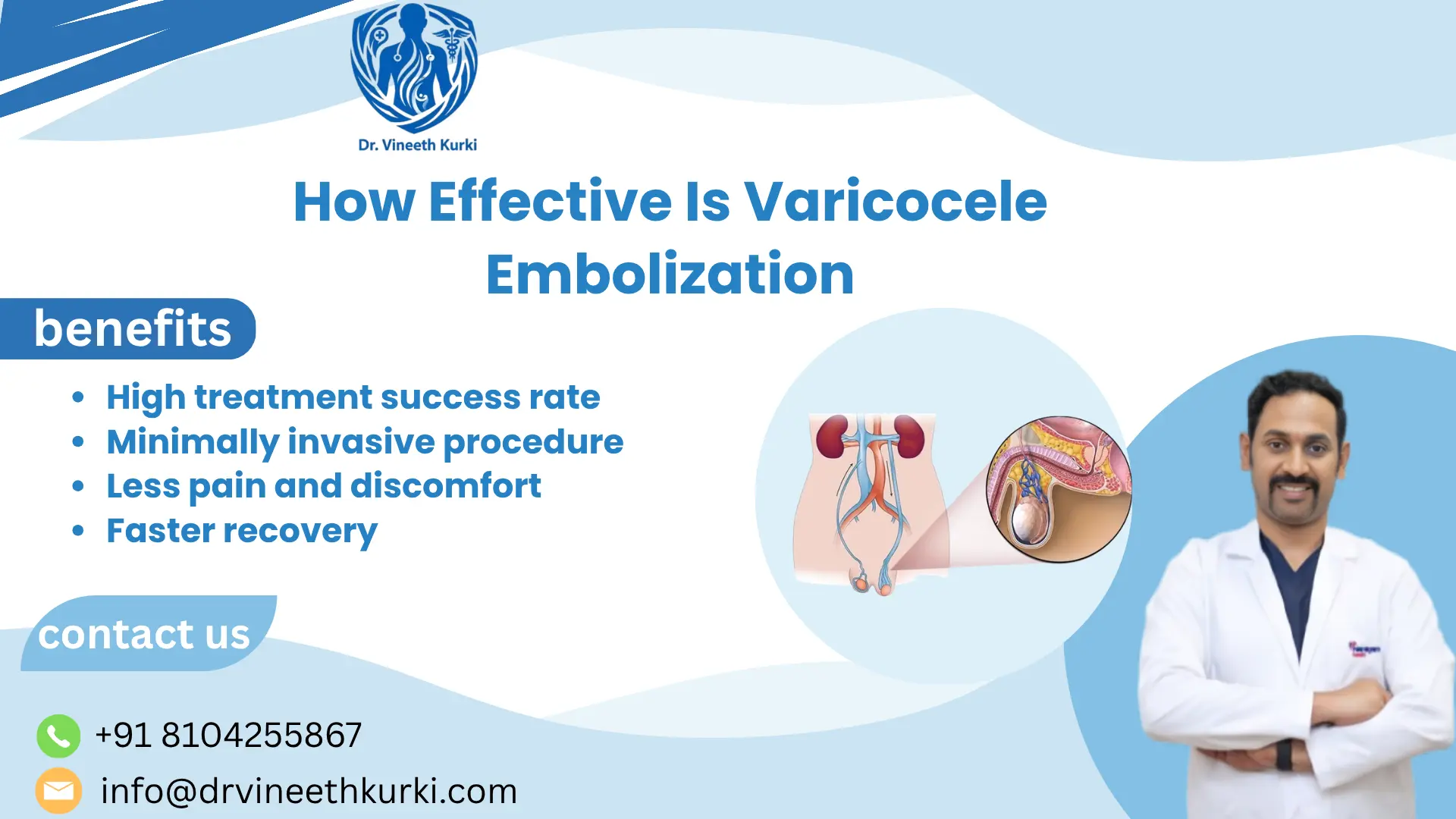
Varicocele is a common condition in which the veins around the testicle become enlarged because of abnormal blood flow. While some varicoceles cause no symptoms, others may lead to scrotal discomfort, swelling, a heavy sensation, or fertility-related concerns. When treatment is required, Varicocele Embolization for Varicocele Treatment has become an important minimally invasive option.
Get Expert Varicocele Treatment Guidance — Book Your Consultation or WhatsApp Us Today.
How Effective Is Varicocele Embolization? It is considered an effective treatment for appropriately selected patients, with RadiologyInfo reporting an approximately 90% technical success rate and recurrence in around 5–10% of cases. Individual outcomes can vary depending on the anatomy of the veins, the severity of the varicocele, the reason for treatment, and the expertise of the treating specialist.
Unlike conventional surgery, embolization does not require a large incision. An interventional radiologist uses imaging guidance to reach and block the abnormal vein, redirecting blood through healthier veins. This can help reduce pressure in the affected veins and improve symptoms.
Understanding Varicocele and When Treatment May Be Needed
A varicocele is a group of enlarged veins in the scrotum, similar in principle to varicose veins in the legs. Normally, valves in the veins help blood move in one direction. When these valves do not function properly, blood can pool around the testicle, causing the veins to enlarge.
Symptoms of Varicocele
Some people have no noticeable symptoms, while others may experience:
- A dull or aching pain in the scrotum
- A feeling of heaviness or dragging
- Scrotal swelling
- Enlarged or twisted veins that may become more prominent while standing
- Discomfort after prolonged standing or physical activity
- Fertility problems or abnormal semen parameters
- Differences in testicular size in some patients
Pain associated with a varicocele may become more noticeable after exercise, standing for long periods, or cycling.
Causes and Risk Factors
The exact reason a varicocele develops can vary, but faulty venous valves and impaired drainage from the testicular veins are important factors. Varicoceles are more commonly found on the left side because of differences in venous anatomy.
A varicocele does not automatically require treatment. If it is small and produces no symptoms or fertility concerns, a doctor may recommend observation. Treatment decisions should be based on symptoms, clinical findings, fertility goals, testicular health, and other relevant medical factors.
Diagnosis of Varicocele
Diagnosis generally begins with a medical history and physical examination. The doctor may examine the scrotum while the patient is standing and may ask the patient to perform a Valsalva maneuver.
A scrotal ultrasound with Doppler can provide additional information about the veins and blood flow and may help confirm the diagnosis or assess the severity of the condition.
For patients being evaluated for fertility concerns, semen analysis may also be recommended. The appropriate diagnostic approach depends on the patient’s symptoms and clinical situation.
How Effective Is Varicocele Embolization?
The effectiveness of Varicocele Embolization for Varicocele Treatment depends on what the treatment is intended to achieve. For many patients, the goals include reducing pain or discomfort, treating the abnormal venous drainage, and potentially supporting fertility-related outcomes.
RadiologyInfo states that embolization has a reported success rate of about 90%, while approximately 5–10% of patients may experience recurrence. These figures should not be interpreted as a guarantee for an individual patient.
For fertility, treatment does not guarantee pregnancy because male infertility can have multiple causes. However, treatment of a clinically significant varicocele may improve sperm-related parameters in appropriately selected patients.
Varicocele Embolization Procedure, Benefits and Recovery
How Effective Is Varicocele Embolization? One major reason patients consider this approach is that it treats the abnormal vein without conventional open surgery.
How Varicocele Embolization Is Performed
Varicocele embolization is generally performed by a specially trained interventional radiologist using X-ray and contrast imaging.
The procedure generally involves:
- The patient is positioned comfortably in the interventional radiology procedure room.
- Local anaesthetic is used at the catheter entry site.
- A thin catheter is introduced through a vein, commonly through the groin or neck.
- Using imaging guidance, the catheter is carefully advanced toward the affected testicular vein.
- Contrast is injected to map the abnormal venous drainage.
- Small coils, a sclerosant, or another embolic material may be used to block the abnormal vein.
- Blood is redirected through healthier veins.
- The catheter is removed and pressure is applied to the entry site.
The procedure is commonly performed as an outpatient or day-case treatment, although arrangements can vary between patients and hospitals.
Benefits of Varicocele Embolization
Potential benefits include:
- Minimally invasive treatment
- No large surgical incision
- Usually no stitches at the treatment site
- Short recovery period
- Ability to target abnormal venous blood flow using imaging
- Potential improvement in varicocele-related pain and discomfort
- Potential improvement in sperm quality in appropriately selected patients
- Treatment can often be performed as a day-case procedure
RadiologyInfo notes that recovery is generally shorter than with surgery and reports outcomes comparable to more invasive surgical techniques in appropriate patients.
Recovery After Embolization
Recovery is usually relatively quick. Some patients may experience temporary discomfort in the groin, lower back, or scrotum after the procedure. Mild bruising at the catheter entry site can also occur.
Many patients can return to normal activities within approximately 24 hours, although individual instructions may differ. Some localized scrotal discomfort can continue for several days, and patients should follow their treating doctor’s advice regarding exercise, heavy lifting, and sexual activity.
Varicocele Embolization vs Surgery
Both embolization and surgical approaches can be used for treating varicoceles. The most appropriate option depends on the patient’s anatomy, symptoms, fertility objectives, previous treatment, and specialist assessment.
Embolization offers a catheter-based alternative that avoids conventional surgical incision. However, it is not suitable for every patient, and sometimes the abnormal vein cannot be successfully accessed. Recurrence is also possible after either embolization or surgery.
The decision should therefore be individualized rather than based only on the procedure being minimally invasive.
Risks and Limitations
How Effective Is Varicocele Embolization? Although the procedure has a strong success profile, it is not completely risk-free.
Possible complications can include bruising or bleeding at the catheter entry site, infection, contrast-related allergic reactions, inflammation of the veins, temporary scrotal discomfort, and, rarely, migration of an embolic device or injury to a blood vessel.
There is also a possibility that the varicocele may recur. RadiologyInfo reports recurrence in approximately 5–10% of patients.
About Dr. Vineeth Kurki and His Services
Dr. Vineeth Kurki is an Endovascular Interventional Radiologist who focuses on image-guided, minimally invasive approaches to vascular and related medical conditions.
For patients considering Varicocele Treatment, consultation with an experienced interventional radiologist can help determine whether embolization is appropriate. Treatment planning may include evaluation of symptoms, imaging findings, venous anatomy, previous treatments, and the patient’s individual goals.
His interventional radiology services can include evaluation and minimally invasive image-guided treatment for selected vascular conditions, including varicocele embolization, where clinically appropriate. The exact treatment plan should always be decided after an individual medical assessment.
FAQs About Varicocele Embolization
1. How Effective Is Varicocele Embolization?
How Effective Is Varicocele Embolization? Published patient information from RadiologyInfo reports an approximately 90% success rate, although outcomes vary between patients. Recurrence may occur in around 5–10% of cases.
2. Is Varicocele Embolization Better Than Surgery?
Neither treatment is universally better. Embolization is minimally invasive and generally has a short recovery, while surgical approaches may be preferred in certain anatomical or clinical situations. A specialist can recommend the most suitable option after evaluation.
3. Does Embolization Cure Varicocele Permanently?
It can successfully close the abnormal vein, but recurrence is possible. RadiologyInfo reports recurrence in approximately 5–10% of treated patients.
4. Can Varicocele Embolization Improve Fertility?
Treatment may improve sperm-related parameters in appropriately selected men, but it cannot guarantee pregnancy because fertility can be affected by many factors.
5. Is Varicocele Embolization Painful?
The procedure is performed with local anaesthesia, and sedation may also be used. Patients may experience pressure during catheter placement and temporary discomfort afterward.
6. How Long Does Recovery Take?
Recovery is generally short. Many patients can resume normal activities within about a day, although mild scrotal or access-site discomfort may persist for several days.
7. Can a Varicocele Return After Embolization?
Yes. Recurrence is possible after embolization, just as it can occur following surgery. In some cases, repeat treatment or another treatment approach may be considered.
8. Who Performs Varicocele Embolization?
The procedure is performed by a specially trained interventional radiologist, who uses imaging guidance to navigate the catheter and treat the abnormal vein.
9. Is Varicocele Treatment Necessary for Everyone?
No. Some varicoceles do not cause symptoms or fertility-related concerns and may simply be monitored. Treatment is considered when there is an appropriate clinical reason, such as persistent symptoms or selected fertility concerns.
Conclusion
How Effective Is Varicocele Embolization? For appropriately selected patients, it is a well-established minimally invasive option with a high technical success rate and the potential to relieve varicocele-related symptoms. It can also be considered in selected patients with fertility concerns.
Varicocele Embolization for Varicocele Treatment offers the advantage of treating abnormal venous blood flow through a small catheter rather than conventional surgery. However, no treatment is appropriate for everyone, and individual outcomes depend on the patient’s anatomy, condition, treatment goals, and specialist assessment.
If you are experiencing scrotal pain, swelling, enlarged veins, or fertility concerns, a proper evaluation can help determine whether treatment is necessary and which approach is most suitable.
Book a Consultation with Dr. Vineeth Kurki
Considering Varicocele Treatment or want to know whether embolization is suitable for you? Book a consultation with Dr. Vineeth Kurki, Endovascular Interventional Radiologist, for an individualized evaluation and discussion of minimally invasive treatment options.
For more information or to schedule a consultation, visit Dr. Vineeth Kurki, Endovascular Interventional Radiologist, in Bengaluru, and take the first step toward discussing your treatment options.