

Varicocele is a common condition in men in which the veins surrounding the testicle become enlarged and twisted. Although some varicoceles cause no symptoms, others may lead to scrotal discomfort, a feeling of heaviness, testicular changes, or fertility problems. When treatment is recommended, varicocele embolization is a minimally invasive option that can treat the abnormal blood flow without conventional open surgery.
For patients considering treatment, understanding the Varicocele Embolization Cost in Bangalore is important. However, the total expense can vary depending on the severity of the varicocele, imaging requirements, embolization materials, hospital facilities, medications, and follow-up care.
This guide explains the symptoms, causes, diagnosis, available treatment options, procedure, benefits, recovery, and factors that influence treatment costs. It also discusses how Varicocele Treatment in Bangalore can be planned according to the patient’s individual condition.
Understanding Varicocele and Its Symptoms
A varicocele is an enlargement of the veins in the scrotum, usually caused by impaired drainage of blood from the testicular veins. It is somewhat similar to varicose veins in the legs.
Many men have mild varicoceles without noticeable symptoms. In others, the condition may become more apparent with standing, physical activity, or prolonged periods of sitting.
Common symptoms
Symptoms may include:
- Dull or aching pain in the scrotum
- Heaviness or dragging sensation
- Swelling or enlarged veins around the testicle
- Discomfort that becomes worse after standing or exercise
- Testicular size changes in some patients
- Fertility difficulties
- Abnormal semen-analysis results
- A visible or palpable collection of enlarged veins
Pain is not always present. Some men discover a varicocele during an examination for infertility.
The severity of symptoms does not necessarily correspond directly to the size of the varicocele. Therefore, a proper clinical assessment is important before deciding on treatment.
Causes, Diagnosis and Treatment Options
The exact mechanism behind varicocele formation is related to abnormal blood flow and inadequate functioning of valves in the testicular veins. The anatomy of the venous system also makes varicoceles more common on the left side.
Causes and risk factors
Possible contributing factors include:
- Dysfunction of venous valves
- Increased pressure within the testicular veins
- Anatomical differences in venous drainage
- Abnormal venous reflux
- Less commonly, an obstruction affecting venous drainage
A newly developed right-sided varicocele, particularly in an older adult, may require careful medical assessment to exclude an underlying abdominal or retroperitoneal cause.
Diagnosis
Diagnosis generally begins with a physical examination. The doctor may examine the scrotum while the patient is standing and may ask him to perform a Valsalva manoeuvre.
A scrotal Doppler ultrasound is commonly used to confirm the diagnosis and assess:
- Vein diameter
- Venous reflux
- Blood-flow characteristics
- Testicular size
- Presence and grade of varicocele
- Other possible causes of scrotal symptoms
For men concerned about fertility, semen analysis may also be recommended. Hormonal testing can be considered when clinically appropriate.
Treatment options
Not every varicocele requires treatment. Observation may be appropriate when the condition causes no significant symptoms or fertility concerns.
When intervention is indicated, treatment may include:
- Surgical varicocelectomy – abnormal veins are surgically ligated.
- Microsurgical varicocelectomy – a specialized surgical approach designed to preserve important structures.
- Percutaneous varicocele embolization – an interventional radiology procedure that blocks abnormal venous flow through a small catheter.
For appropriately selected patients, embolization can be a useful Non-Surgical Varicocele Treatment because it does not require an incision in the groin or scrotum.
Varicocele Embolization Procedure, Cost and Benefits
The Varicocele Embolization Cost in Bangalore should be discussed with the treating interventional radiologist because there is no single fixed price applicable to every patient.
What happens during embolization?
Varicocele embolization is performed by an interventional radiologist using image guidance.
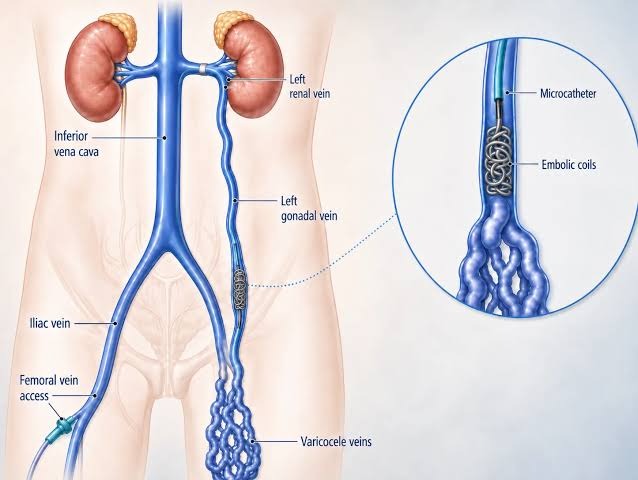
A typical procedure involves:
- Local anaesthesia is administered.
- A small catheter is introduced through a suitable vein, commonly through the neck or groin depending on the patient’s venous anatomy and operator preference.
- The catheter is guided toward the abnormal testicular or gonadal vein.
- Venography may be performed to identify reflux and venous anatomy.
- An embolizing material, such as coils or another suitable agent, is used to block abnormal venous flow.
- Blood is redirected through healthier veins.
- The catheter is removed and the access site is dressed.
The exact technique and embolic material are selected according to venous anatomy, the type of reflux, and the treating specialist’s expertise.
What determines Varicocele Embolization Cost in Bangalore?
Patients often search for a precise figure, but treatment costs can differ between hospitals and individuals.
Major factors include:
- Consultation and specialist fees
- Doppler ultrasound and other investigations
- Hospital or day-care charges
- Interventional radiology procedure fees
- Type and quantity of embolization materials
- Anaesthesia or sedation requirements
- Complexity of venous anatomy
- Whether additional veins require embolization
- Medications and consumables
- Follow-up consultations and imaging
Therefore, instead of choosing a treatment based solely on the lowest quoted price, patients should ask what is included in the package.
The Varicocele Embolization Cost in Bangalore should ideally be provided after reviewing the patient’s imaging and medical history so that the estimate reflects the actual procedure required.
Benefits of embolization
Potential advantages of embolization include:
- No conventional surgical incision
- Minimally invasive approach
- Usually performed through a small vascular access point
- Generally short hospital or day-care stay
- No stitches in the scrotum
- Relatively quick return to routine activities
- Ability to treat venous reflux under imaging guidance
- Can be an alternative when surgery is unsuitable or has previously failed
However, embolization is not appropriate for every patient. A specialist should determine whether the venous anatomy and clinical indication make the procedure suitable.
Published clinical experience, including work involving Dr. Vineeth Kurki during his interventional radiology training, has evaluated percutaneous varicocele embolization using coils and embolic agents in symptomatic patients. In that small study, technically successful embolization was achieved in all 12 treated patients, with improvement in pain at one-month follow-up.
Because that was a small retrospective series, its results should not be interpreted as a guarantee for every patient.
Varicocele embolization vs surgery
| Feature | Varicocele Embolization | Surgical Varicocelectomy |
| Approach | Catheter-based | Surgical |
| Large incision | Usually no | Depends on technique |
| Anaesthesia | Often local ± sedation | Usually regional/general depending on technique |
| Hospital stay | Often short/day care | Depends on surgical approach |
| Recovery | Generally quick | Can take longer |
| Specialist | Interventional radiologist | Urologist/surgeon |
| Recurrence | Possible | Possible |
| Suitability | Depends on venous anatomy and clinical factors | Depends on clinical and surgical factors |
The best option depends on the individual patient rather than simply choosing between “surgery” and “non-surgical” treatment.
Recovery, Doctor Profile and Frequently Asked Questions
Recovery after varicocele embolization
Recovery is generally straightforward, although instructions vary according to the procedure and the patient’s health.
Patients may experience mild discomfort or bruising around the catheter-entry site for a short period. Doctors commonly advise avoiding strenuous exercise and heavy lifting temporarily.
Most people can gradually return to normal activities according to their doctor’s instructions. Follow-up may include clinical assessment and, when indicated, Doppler ultrasound or semen analysis.
Patients should seek medical attention if they develop significant bleeding, increasing swelling, fever, severe pain, or other unexpected symptoms.
About Dr. Vineeth Kurki
Dr. Vineeth Kurki is an Endovascular Interventional Radiologist associated with interventional radiology services in Bengaluru. Publicly available professional material identifies his involvement in interventional radiology and research related to percutaneous varicocele embolization.
His interventional radiology-focused approach involves minimally invasive, image-guided procedures rather than conventional open operations. For patients considering varicocele treatment, the consultation can focus on confirming the diagnosis, reviewing Doppler findings, assessing symptoms and fertility concerns, and determining whether embolization is appropriate.
Services offered
Depending on clinical indication and availability, an interventional radiology practice may provide minimally invasive image-guided treatments for conditions such as:
- Varicocele embolization
- Vascular and venous interventions
- Image-guided embolization procedures
- Other endovascular treatments
- Minimally invasive treatment for selected vascular conditions
The exact services available should always be confirmed directly with the doctor’s clinic or hospital.
Frequently Asked Questions
1. What is the average Varicocele Embolization Cost in Bangalore?
There is no universal fixed cost. The final amount depends on the hospital, embolization materials, diagnostic tests, procedure complexity, specialist fees, and follow-up requirements. A personalized estimate is more reliable than a generic online figure.
2. Is varicocele embolization a Non-Surgical Varicocele Treatment?
Yes. Embolization is a catheter-based interventional radiology treatment and does not involve conventional surgical ligation through a groin or scrotal incision.
3. Is varicocele embolization painful?
The procedure is generally performed with local anaesthesia, sometimes with sedation. Patients may experience pressure or mild discomfort during or after the procedure, but individual experiences vary.
4. How long does varicocele embolization take?
The procedure duration varies according to venous anatomy and technical complexity. Your interventional radiologist can provide a more accurate estimate after reviewing your imaging.
5. Can embolization improve fertility?
Varicocele treatment may improve semen parameters in appropriately selected men, particularly when a clinically significant varicocele is associated with infertility and abnormal semen analysis. However, fertility outcomes vary and treatment cannot guarantee pregnancy.
6. How soon can I return to work?
Many patients can return to routine activities relatively quickly, depending on their occupation and recovery. Heavy lifting and strenuous exercise may need to be avoided temporarily.
7. Can a varicocele come back after embolization?
Recurrence or persistent varicocele is possible after any treatment. Venous anatomy and the presence of collateral veins can influence treatment success.
8. Is embolization better than surgery?
Neither treatment is universally better. Embolization may be attractive to patients seeking a minimally invasive option, while surgery may be preferable in other clinical circumstances. A specialist should assess the individual case.
9. What tests are needed before treatment?
A physical examination and scrotal Doppler ultrasound are commonly used. Men being evaluated for infertility may also require semen analysis and, when indicated, additional laboratory testing.
10. Does a varicocele always require treatment?
No. Many asymptomatic varicoceles can be monitored. Treatment is generally considered when symptoms, testicular concerns, infertility, or other clinically relevant factors justify intervention.
Conclusion
Understanding the Varicocele Embolization Cost in Bangalore is important, but cost should be considered alongside the expertise of the treating specialist, hospital facilities, embolization technique, expected recovery, and individual medical requirements.
Varicocele embolization offers a minimally invasive approach for appropriately selected patients and can avoid conventional surgical incision. However, the right treatment depends on the severity of the condition, symptoms, fertility goals, Doppler findings, venous anatomy, and overall health.
If you have been diagnosed with a varicocele or are experiencing scrotal pain, heaviness, swelling, or fertility concerns, an expert evaluation can help determine whether Varicocele Treatment in Bangalore is appropriate for you.
For an individualized assessment, treatment discussion, and accurate estimate of the Varicocele Embolization Cost in Bangalore, consult Dr. Vineeth Kurki, Endovascular Interventional Radiologist. Discuss your symptoms, Doppler report, fertility concerns, and available treatment options with the specialist before making a decision.
Book an appointment with Dr. Vineeth Kurki today to discuss whether minimally invasive varicocele embolization is suitable for you and get a personalized treatment plan.