
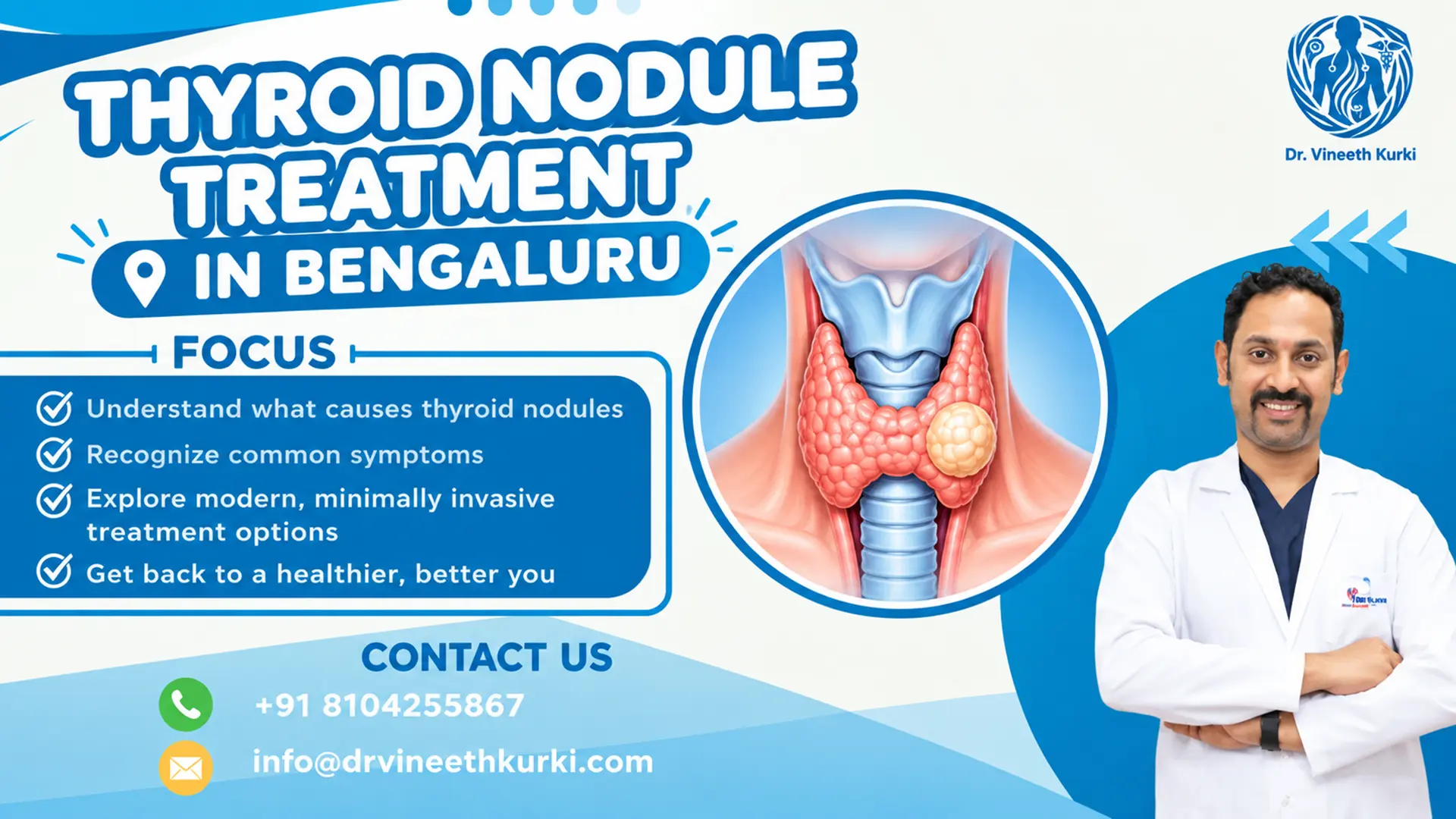
Thyroid Nodule Treatment in Bengaluru depends on the size, appearance, thyroid function, symptoms, and whether a nodule is benign or suspicious. Thyroid nodules are common, and most are benign. However, some nodules can become large enough to cause neck discomfort, swallowing difficulty, visible swelling, or cosmetic concerns.
For appropriately selected benign nodules, Thyroid Nodule Ablation can provide a minimally invasive treatment option. Radiofrequency ablation (RFA), for example, uses ultrasound guidance to deliver controlled thermal energy into the nodule, causing the treated tissue to shrink over time.
This article explains Thyroid Nodule Treatment in Bengaluru, including symptoms, causes, diagnosis, ablation, benefits, recovery, and how minimally invasive treatment compares with conventional surgery.
Thyroid Nodule Treatment in Bengaluru: Symptoms, Causes & Diagnosis
A thyroid nodule is a lump or abnormal area within the thyroid gland. Nodules may be solid, cystic, or mixed. Many are discovered incidentally during a neck examination or imaging performed for another reason.
Symptoms of Thyroid Nodules
Many thyroid nodules do not produce symptoms. When a nodule becomes larger, however, it may cause:
- A visible or palpable lump in the neck
- Neck pressure or discomfort
- Difficulty swallowing
- A sensation of something pressing in the throat
- Difficulty breathing when a large nodule compresses nearby structures
- Hoarseness or voice changes in some cases
- Cosmetic concerns because of a visible neck swelling
Some nodules can also produce excess thyroid hormone. These are called autonomously functioning or toxic nodules and may be associated with symptoms such as palpitations, tremors, heat intolerance, sweating, anxiety, or unexplained weight loss.
Causes and Risk Factors
The exact cause of an individual thyroid nodule may not always be identifiable. Nodules can develop because of changes in thyroid tissue, fluid accumulation, inflammation, or other thyroid conditions.
Factors that may be associated with thyroid nodules include age, sex, iodine status, previous radiation exposure, family history, and underlying thyroid disease. Importantly, the presence of a thyroid nodule does not automatically mean cancer. The American Thyroid Association notes that most thyroid nodules are benign.
Diagnosis of Thyroid Nodules
Accurate diagnosis is essential before deciding on Thyroid Nodule Treatment in Bengaluru.
The evaluation may include:
Clinical examination: The doctor examines the neck and thyroid and asks about symptoms, duration, medical history, and family history.
Thyroid ultrasound: Ultrasound is an important investigation for characterizing the size and structural features of a thyroid nodule.
Blood tests: Thyroid-stimulating hormone (TSH) and other thyroid hormone tests may be recommended to determine whether the thyroid is functioning normally.
Fine-needle aspiration biopsy: Depending on the ultrasound findings and nodule size, a fine-needle aspiration may be recommended to determine whether the nodule is benign or suspicious.
Proper assessment is particularly important before considering ablation because thyroid ablation is primarily used for appropriately selected benign nodules. The American Thyroid Association has published specific safety principles for ablation techniques used for benign thyroid nodules.
Thyroid Nodule Treatment in Bengaluru: Thyroid Nodule Ablation Procedure
Not every thyroid nodule needs active treatment. Small, asymptomatic benign nodules may simply require periodic monitoring. Treatment may be considered when a benign nodule causes symptoms, cosmetic concerns, or other clinically significant problems.
What Is Thyroid Nodule Ablation?
Thyroid Nodule Ablation is a minimally invasive technique that destroys targeted thyroid nodule tissue while aiming to preserve surrounding healthy thyroid tissue.
Radiofrequency ablation is one commonly used technique. During RFA, an ultrasound-guided electrode is carefully positioned inside the nodule. Radiofrequency energy generates controlled heat, which treats the targeted tissue. The treated nodule then gradually decreases in volume over time.
The American Thyroid Association describes thermal and chemical ablation as minimally invasive, nonsurgical techniques for appropriately selected benign thyroid nodules and emphasizes the need for appropriate training and safety protocols.
How the Procedure Is Performed
A typical ablation procedure may involve:
- Ultrasound examination to map the nodule and surrounding structures.
- Cleaning and preparing the treatment area.
- Local anaesthesia to numb the skin and treatment region.
- Placement of the ablation electrode under continuous ultrasound guidance.
- Controlled delivery of energy to the targeted portions of the nodule.
- Careful movement of the electrode to treat the planned areas.
- Removal of the electrode after the treatment is completed.
- Short observation before discharge, depending on the patient’s condition and clinical protocol.
The precise technique depends on the nodule’s location, size, composition, relationship to nearby structures, and the physician’s assessment.
Who May Be a Candidate?
Thyroid Nodule Treatment in Bengaluru with ablation may be considered for selected patients with benign nodules that cause pressure symptoms, swallowing discomfort, cosmetic concerns, or other clinically significant problems.
Ablation is not automatically appropriate for every thyroid nodule. Suspicious or confirmed malignant nodules require a different evaluation and treatment pathway. The American Thyroid Association’s guidance specifically addresses safe adoption of ablation techniques for benign thyroid nodules.
Thyroid Nodule Ablation vs Surgery
| Feature | Thyroid Nodule Ablation | Conventional Surgery |
| Approach | Minimally invasive | Surgical |
| Incision | Needle access rather than a conventional neck incision | Neck incision |
| Anaesthesia | Often performed with local anaesthesia | Anaesthesia depends on surgery |
| Thyroid tissue | Aims to preserve functioning thyroid tissue | Part or all of the thyroid may be removed |
| Recovery | Generally shorter | Usually longer |
| Scar | No conventional surgical neck scar | Surgical scar is expected |
| Suitability | Selected benign nodules | Depends on diagnosis and clinical indication |
Surgery remains an important treatment for nodules that require removal, particularly when cancer is suspected or confirmed, or when the anatomy and clinical circumstances make surgery more appropriate. Ablation should therefore be viewed as a treatment option for selected patients rather than a universal replacement for surgery.
Thyroid Nodule Treatment in Bengaluru: Benefits, Recovery & Doctor
For appropriately selected patients, Thyroid Nodule Treatment in Bengaluru using ablation can offer a minimally invasive approach while avoiding a conventional surgical neck incision.
Potential Benefits of Thyroid Nodule Ablation
Potential benefits may include:
- Minimally invasive treatment
- No conventional surgical neck incision
- Preservation of much of the surrounding thyroid tissue
- Reduced disruption to daily activities compared with major surgery
- Treatment under ultrasound guidance
- Improvement in pressure-related symptoms as the nodule shrinks
- Improvement in visible neck swelling in appropriately selected cases
- Potentially less recovery time than conventional thyroid surgery
The American Thyroid Association reports that thermal ablation techniques can produce substantial thyroid nodule volume reduction and have been developed as alternatives to surgery for selected benign nodular disease.
However, results vary between patients. The purpose of treatment, expected degree of shrinkage, number of sessions, and follow-up plan should be discussed individually.
Recovery After Ablation
Recovery following Thyroid Nodule Treatment in Bengaluru with ablation is generally focused on observation, symptom monitoring, and follow-up imaging.
Some patients may experience temporary:
- Mild neck discomfort
- Local tenderness
- Swelling
- A feeling of tightness
- Temporary voice changes or other symptoms that require medical assessment
The treating physician provides specific post-procedure instructions based on the technique used and the patient’s condition. Follow-up ultrasound examinations are generally important to monitor changes in nodule volume and clinical symptoms.
The American Thyroid Association emphasizes that thyroid ablation requires appropriate procedural expertise, patient selection, and attention to safety before, during, and after treatment.
Thyroid Nodule Treatment in Bengaluru With Dr. Vineeth Kurki
Patients considering Thyroid Nodule Treatment in Bengaluru can consult Dr. Vineeth Kurki, Interventional Radiologist in Bengaluru, for evaluation of suitable minimally invasive treatment options.
His interventional radiology services can include image-guided procedures designed to treat selected conditions through minimally invasive techniques. For thyroid nodules, treatment planning should begin with a detailed review of ultrasound findings, thyroid function, biopsy results where indicated, symptoms, and the location and characteristics of the nodule.
A specialist consultation can help determine whether Thyroid Nodule Ablation is appropriate or whether observation, surgery, or another treatment approach would be more suitable.
Frequently Asked Questions About Thyroid Nodule Treatment in Bengaluru
1. Is every thyroid nodule treated?
No. Many thyroid nodules are benign and do not require immediate treatment. Monitoring may be appropriate when a nodule is small, asymptomatic, and does not have concerning features.
2. What is Thyroid Nodule Ablation?
Thyroid Nodule Ablation is a minimally invasive procedure that uses controlled energy to destroy targeted nodule tissue. Radiofrequency ablation is one established technique used for selected benign thyroid nodules.
3. Can thyroid nodules be treated without surgery?
Yes. Selected benign thyroid nodules may be treated using minimally invasive techniques such as radiofrequency ablation. Whether this approach is appropriate depends on the diagnosis, symptoms, nodule characteristics, and specialist assessment.
4. Is ablation suitable for cancerous thyroid nodules?
Ablation is primarily discussed for appropriately selected benign thyroid nodules. A suspicious or confirmed thyroid cancer requires specialist cancer evaluation and a treatment plan based on its type, size, location, and other risk factors.
5. Does thyroid ablation remove the whole nodule immediately?
No. Ablation treats the targeted tissue, which is then gradually resorbed and reduced in volume. Follow-up imaging is used to assess the response over time.
6. Is Thyroid Nodule Ablation painful?
The procedure is generally performed with local anaesthesia, although patients may experience pressure or temporary discomfort. The exact experience varies depending on the procedure and individual sensitivity.
7. Can thyroid function be preserved after ablation?
A major aim of ablation for suitable benign nodules is to treat the abnormal tissue while preserving healthy thyroid tissue. However, thyroid function can vary between patients and should be monitored as recommended by the treating physician.
8. How long does recovery take after thyroid ablation?
Recovery is generally shorter than that associated with conventional thyroid surgery, but the exact timeframe depends on the procedure, nodule characteristics, and individual response. Your doctor will provide personalized post-procedure instructions.
9. Is ultrasound important before thyroid nodule treatment?
Yes. Ultrasound is an important tool for evaluating thyroid nodules and determining their size and structural characteristics. Further tests, including biopsy, may be recommended depending on the findings.
10. How can I know whether ablation is right for me?
A consultation with an experienced specialist is important. Your doctor can review your ultrasound, thyroid blood tests, biopsy results when indicated, symptoms, and medical history before recommending monitoring, ablation, surgery, or another treatment.
Conclusion
Thyroid Nodule Treatment in Bengaluru should always begin with an accurate diagnosis and individualized treatment plan. While many thyroid nodules can simply be monitored, symptomatic or clinically significant benign nodules may require active treatment.
Thyroid Nodule Ablation is a minimally invasive option that can reduce the volume of selected benign thyroid nodules while avoiding a conventional surgical neck incision. Radiofrequency ablation and other ablation techniques have developed as alternatives for appropriately selected patients, with professional guidance emphasizing careful patient selection, procedural expertise, and safety.
If you have a thyroid nodule, neck swelling, pressure symptoms, or are looking for a minimally invasive treatment option, consult Dr. Vineeth Kurki, Interventional Radiologist in Bengaluru. Book an appointment to discuss your diagnosis, available treatment options, and whether Thyroid Nodule Ablation is appropriate for you.